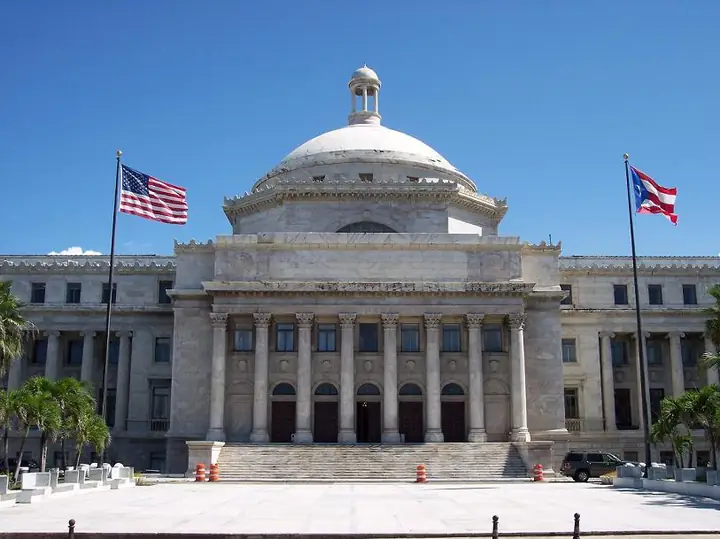
Just east of Old San Juan's walls, on the narrow strip of land called Puerta de Tierra, a white marble dome rises between the Atlantic and the main avenues into the city. This is El Capitolio, the seat of Puerto Rico's Legislative Assembly, with the Senate and the House of Representatives meeting in its two wings. For many Puerto Ricans it is a symbol of self-government, and for visitors it is one of the finest public interiors on the island, with a rotunda where the Constitution of Puerto Rico is on display.
History
Calls for a proper capitol building go back to the early 1900s, when Luis Muñoz Rivera, the island's leading political figure of the era and later its Resident Commissioner in Washington, was among those pushing for a home for an elected legislature. He died in 1916 and did not see it built. The design came from Puerto Rican architect Rafael Carmoega, working for the island's Department of the Interior, after a design competition. Construction took most of the 1920s, and the building was inaugurated on February 11, 1929.
The style is Neoclassical Beaux-Arts, and Carmoega is often said to have drawn on Columbia University's Low Memorial Library in New York; the double-shelled dome follows the model of the Pantheon in Rome. The dome itself was not completed until 1961. Work on the rotunda's interior continued into the early 1960s, when the stained-glass coat of arms and the dome mosaics were installed.
Across the north facade, facing the ocean, runs a line attributed to Muñoz Rivera: "El derecho, la libertad y la dignidad por encima de todo" (Law, liberty and dignity above all).
What you see inside
The building is clad inside and out in marble, with many varieties sourced from Italy, the mainland United States and Spain. Highlights:
- The rotunda. Look up into the dome, where mosaics made of millions of pieces of Venetian glass, completed in 1962 by a team led by Italian artist Gino Garibaldi, depict allegorical muses representing freedom, education, agriculture, the arts and letters, science, industry and commerce, health and justice.
- The Constitution of Puerto Rico, which took effect in 1952 and is displayed in the rotunda in a protective glass case.
- Murals, reliefs and decorative work by Puerto Rican artists including Rafael Ríos Rey, José Oliver, Rafael Tufiño and Jorge Rechany, which tell the island's history.
- The legislative chambers of the Senate and House, when they are not in session and the tour includes them.
The University of Puerto Rico's Architecture and Construction Archives hold a collection of Carmoega-era drawings, photographs and documents for the building, a resource for anyone interested in its design.
Visiting and tours
The Capitol is a working legislature, and access to the interior is organized through the Legislative Assembly's Capitol tourism office, which coordinates historical tours of the building and the surrounding Capitol District. According to its official tourism page, the office works Monday through Friday, 8:30 a.m. to 4:30 p.m., and tours are requested in advance with a form available in Spanish and English. Tours have historically been free; confirm the details when you book. Groups and anyone hoping to see the chambers should allow plenty of lead time.
Expect a security check at the entrance, and carry a photo ID. Dress as you would for a government office. Sessions, official ceremonies and public hearings can change what parts of the building are open on a given day. If you'd like to watch the legislature at work, ask the tourism office when the chambers are in session.
Around the Capitol
Even without a tour, the grounds are worth a walk. On the south side, along Avenida de la Constitución, the Paseo de los Presidentes displays life-size bronze statues of U.S. presidents who visited Puerto Rico while in office, an idea launched in the Senate in 2008. On the ocean side, the Capitol looks out over a stretch of rocky shoreline, with views east along the coast toward the Caribe Hilton and Condado.
Getting there
The Capitol stands between Avenida Ponce de León and Avenida Muñoz Rivera in Puerta de Tierra, about a ten-minute walk east of Plaza Colón and Castillo San Cristóbal. Walking from Old San Juan is the easiest option; the route along Avenida Ponce de León is flat, though exposed to the sun. AMA public buses heading into Old San Juan use these avenues; check current routes and stops with the Metropolitan Bus Authority. Taxis and rideshare are simple. If you are driving, street parking nearby is limited and largely taken by legislative staff on weekdays; parking in an Old San Juan garage and walking over is often easier.
Practical tips
- How long: about an hour for a guided visit; 15 to 20 minutes to walk the exterior and the Paseo de los Presidentes.
- Book early. Send your tour request well ahead of your trip, especially for a group.
- Accessibility: ask about accessible entrances when you request the tour; the main steps are monumental.
- Photography: the exterior and grounds are easy to photograph from the street; inside, follow your guide's instructions.
Combine it with
Puerta de Tierra rewards a half day. Walk east to Escambrón Beach, a sheltered balneario popular with San Juan families, and the 18th-century Fortín de San Gerónimo beside the Caribe Hilton. The Ateneo Puertorriqueño, one of the island's oldest cultural institutions, is also in the neighborhood. To the west, Old San Juan begins at Plaza Colón, and across the bridges to the east lies Condado.
Good to know
- Interior visits are by guided tour requested in advance through the Capitol tourism office, Monday to Friday.
- Bring photo ID and expect security screening.
- The Constitution of Puerto Rico is on display in the rotunda.
- The grounds and the Paseo de los Presidentes can be seen at any time from the street.