In the foothills just north of Ponce, the Centro Ceremonial Indígena de Tibes preserves stone-lined ball courts and ceremonial plazas built by Puerto Rico's Indigenous peoples centuries before Columbus arrived. It is one of the most important archaeological sites in the Antilles, and one of the few places in Puerto Rico where you can stand on the actual grounds where ancient communities gathered, played and buried their dead. It's quiet and shady and makes an easy half-day trip from Ponce.
A site uncovered by a storm
Tibes was revealed by accident. In 1975 Tropical Storm Eloise drenched southern Puerto Rico and the Portugués River flooded the farmland of barrio Tibes. When the water receded, it exposed lines of stones and artifacts that turned out to be the edges of an ancient ceremonial complex. Archaeological excavations followed, and a museum on the site opened in the early 1980s.
Work at Tibes uncovered seven bateyes (rectangular ball courts) and two ceremonial plazas, along with a large burial ground with well over a hundred human remains, pottery, tools and ornaments. Archaeologists attribute the earliest occupation to Igneri (Saladoid) peoples in the first centuries AD, followed by later pre-Taíno communities who built the plazas and courts. Tibes is regarded as one of the oldest ceremonial centers yet found in the Antilles, older than the better-known Taíno site at Caguana in Utuado. The alignment of some stones has led researchers to suggest that the plazas may have been oriented to mark astronomical events such as solstices and equinoxes.
Note that Tibes predates the Taíno chiefdoms the Spanish encountered in 1493. When you hear it called a Taíno site, that's shorthand; it is better understood as the work of the Taínos' ancestors.
What you'll see
A visit usually starts at the small museum, which displays artifacts recovered at the site with bilingual explanations, and a short orientation video about the excavations. From there, a guide (when one is available) leads you along paths through the grounds.
- Ball courts. The bateyes are long, flat rectangles edged with upright stones. The ball game played here was both sport and ritual, and the courts were community gathering places.
- Ceremonial plazas. The largest plaza, edged with stones in a pattern often described as star- or sun-shaped, is the highlight. Some stones bear petroglyphs.
- Native trees and plants. Guides point out species the Indigenous inhabitants used for food, medicine, tools and dyes.
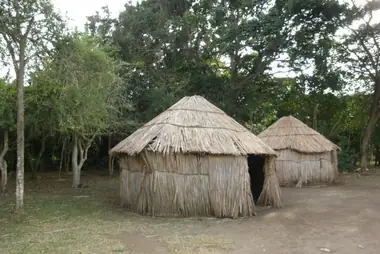
- Reconstructed village. The site has displayed a re-created village with thatched dwellings to show how people may have lived; ask whether it is open on the day you visit, since structures are periodically rebuilt after storms.
Hours, tickets and how visits work
Tibes is operated by the Municipality of Ponce. It has historically opened Tuesday through Saturday or Sunday during daytime hours, closing mid-afternoon, with a modest admission charge and discounts for children and seniors. Schedules and fees have shifted since the hurricanes and earthquakes of recent years, and reservations have sometimes been requested, so call the center or check with Ponce's tourism office before you go. Plan to arrive well before closing so you have time for both the museum and the grounds.
Getting there
Tibes is about 15 to 20 minutes north of downtown Ponce. From the city, take PR-10 north toward Adjuntas and turn onto PR-503; the center is at about kilometer 2.2, and signs mark the turn. There is parking at the site. Ponce itself is roughly an hour and a half from San Juan via the PR-52 toll road. There is no practical public transport to Tibes, so you'll need a car or taxi.
Practical tips
- Go in the morning. The grounds are mostly open and get hot by midday.
- Bring water, a hat, sunscreen and insect repellent; the riverside setting attracts mosquitoes.
- Wear comfortable walking shoes. Paths are flat but include grass and gravel.
- Allow about one and a half to two hours.
- Accessibility: the terrain is mostly level, but surfaces are uneven; contact the center in advance if you use a wheelchair.
- Respect the site. Don't climb on or move the stones; this is an archaeological and burial site.
Combine it with
Tibes pairs naturally with a day in Ponce. Downtown, visit Plaza Las Delicias, the Parque de Bombas and the cathedral, then drive up to Castillo Serrallés and El Vigía for views over the city. If you continue north on PR-10 into the mountains, you reach Adjuntas and the coffee estate at Hacienda Sotomayor. To go deeper into Indigenous history, the petroglyphs at Cueva del Indio on the north coast are another window onto the island's first peoples.
Good to know
- Tibes was uncovered after Tropical Storm Eloise flooded the area in 1975.
- Seven ball courts and two ceremonial plazas are the main features.
- The site predates the Taíno society the Spanish met in 1493.
- Run by the Municipality of Ponce; confirm hours and fees before going.
- Located on PR-503, about 15 to 20 minutes north of downtown Ponce.