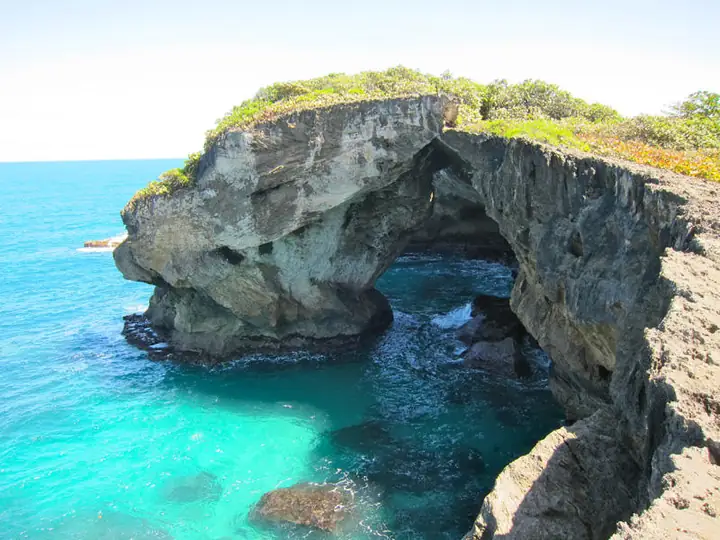
On the Atlantic shore of Arecibo, in the Islote neighborhood, the sea has carved the limestone into cliffs, arches, a natural bridge and blowholes that fire spray into the air on rough days. Among these formations is Cueva del Indio, a sea cave whose walls carry carvings left by the Taíno, the island's Indigenous people. It is said to hold the largest concentration of petroglyphs anywhere on Puerto Rico's coast. It is a short, rugged stop with a real sense of history, and a place where you need to watch your footing and the waves.
Why it matters
The Taíno carved faces, figures and geometric designs into rock across Puerto Rico, often near water and in caves that they treated as sacred or ceremonial places. Nobody knows exactly what the Cueva del Indio carvings meant or when each one was made. Archaeologists generally link this kind of rock art to Taíno beliefs about ancestors and spirits, but it is honest to say that much of the meaning is lost.
The site has layered protections. It was designated an archaeological site in 1988 and a natural reserve in 1992, and its waters became a marine reserve in 2015. The Department of Natural and Environmental Resources (DRNA) is responsible for managing the reserve. The surrounding coast is part of an Important Bird Area, and the seagrass beds offshore support manatees.
Even with those protections, the cave has suffered. Some petroglyphs have been scratched over with modern graffiti, and residents and environmental groups have fought for years over illegal construction and blocked access along this stretch of coast.
Access: what changed in 2025
For years the usual way in was through a privately run lot next to the site, which charged a cash parking fee. In July 2025, DRNA reached a court-supervised settlement with Arecibo residents, environmental groups and Legal Services of Puerto Rico. Under it, DRNA committed to marking and guaranteeing safe, free, public access to the cave. The Municipality of Arecibo agreed to help once permits and road demarcation are complete. DRNA also agreed to prepare a management and conservation plan with the reserve's interagency committee, and the court reviews progress every six months.
Putting those commitments in place on the ground takes time. Ask locally or check DRNA's announcements for the current access route before you go, and carry some small bills in case you end up using a private lot.
What you see
- The cave. The petroglyphs are inside a hollow in the cliff that is open to the sky in places. Getting down into it has meant scrambling through an opening in the rock. The old makeshift ladder that visitors once used has been reported removed. Go only if you are steady on uneven, sharp limestone.
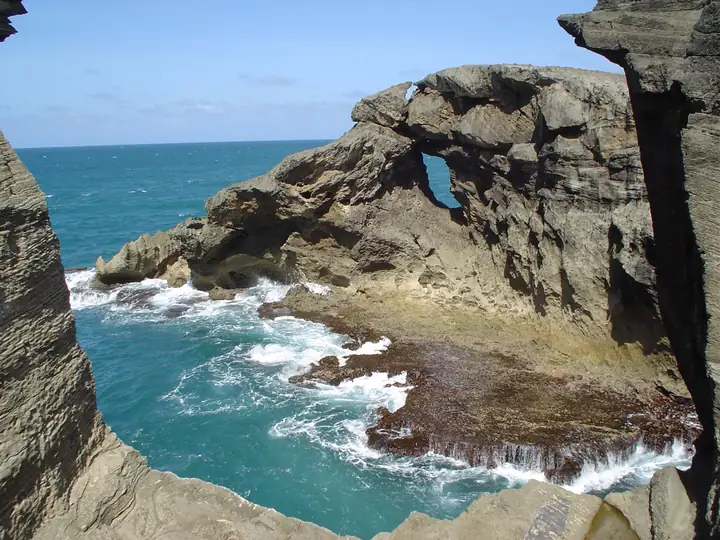
- The coastline. The flat, pitted rock along the top of the cliffs leads to sea arches, a natural bridge and blowholes. When the swell is up, which is common from late fall through early spring on the north coast, waves explode against the rock in spectacular fashion.
- Birds and sea life. Seabirds and shorebirds work the coast, and the protected seagrass offshore supports manatees and other marine life.
Getting there
Cueva del Indio is on the coast east of downtown Arecibo, off PR-681 in the Islote area. From San Juan, take PR-22 west to Arecibo, then follow PR-681 along the shore. Plan on roughly an hour and a quarter from San Juan without heavy traffic. There is no practical public transport, so drive or join a tour.
Safety and practical tips
- No railings. There are no guardrails and no lifeguards. The cliff edges are undercut, and the limestone is jagged. Stay well back from the edge, and keep children within arm's reach.
- Respect the sea. This is not a swimming spot. Rogue waves can wash over the low rock shelves, especially in winter swell. Don't climb onto wet, dark rock near the water.
- Shoes. Wear closed shoes with grip. Flip-flops and sharp karst rock are a bad combination.
- Timing. Visit in the morning or late afternoon, when the light is softer and the bare rock is not as hot. There is little shade, so bring water and sun protection.
- Protect the carvings. Don't touch, chalk, trace or scratch the petroglyphs. Oils from your skin damage them too. Report vandalism to DRNA.
- Time needed. Allow about an hour to explore the cave and the cliffs.
Combine it with
- The Arecibo Observatory site and Arecibo C3 science center, in the hills south of town.
- Cueva Ventana, a guided cave walk on PR-10 with a famous window view over the Río Grande de Arecibo valley.
- Mar Chiquita in Manatí, a dramatic rock-ringed cove a short drive east.
- Río Camuy Cave Park, which has been closed since 2023. Check its reopening status first.
Good to know
- Cueva del Indio is a protected natural reserve and archaeological site. Removing anything, or marking the rock, is illegal.
- Access arrangements are changing under the 2025 settlement, so confirm the current route and whether any parking fee applies.
- There are no facilities at the cave itself. Use restrooms and buy supplies in town beforehand.
- Don't confuse this site with other places called "Cueva del Indio" elsewhere in Puerto Rico. This one is on the Arecibo coast.