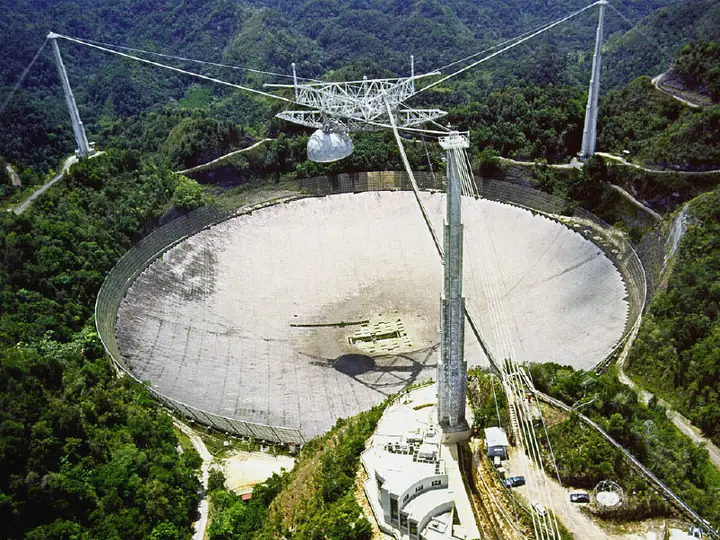
For nearly 60 years, a 305-meter radio dish hung in a sinkhole in the hills south of Arecibo, and it was one of the most recognizable scientific instruments on Earth. That telescope is gone. It collapsed on December 1, 2020, and the U.S. National Science Foundation (NSF) decided not to rebuild it. The site is still worth visiting, but as a different kind of place. Today it is the NSF Arecibo Observatory Historic District, home to the Arecibo C3 STEM Center, a science education center that is gradually opening to the public. This guide covers what happened, what you can see now and how to plan a visit.
What happened to the telescope
The Arecibo Telescope was completed in 1963 and remained the world's largest single-aperture telescope for 53 years, until China's FAST telescope surpassed it in 2016. Work done there changed astronomy. In 1964, astronomers used it to establish Mercury's rotation period. In 1974, they found the first binary pulsar, a discovery that earned a Nobel Prize in Physics in 1993. In the early 1990s, observations made with the dish produced the first confirmed planets outside our solar system, orbiting a pulsar. Many people also know the dish from the films GoldenEye and Contact.
The telescope was damaged by Hurricane María in 2017. Then, in August and November 2020, two support cables failed. Engineers judged that the structure could not be repaired safely, and NSF announced on November 19, 2020, that it would decommission the telescope. Before that could happen, more cables gave way on December 1, 2020, and the suspended instrument platform crashed into the dish. In October 2022, NSF confirmed that it would not rebuild and would turn the site toward science education.
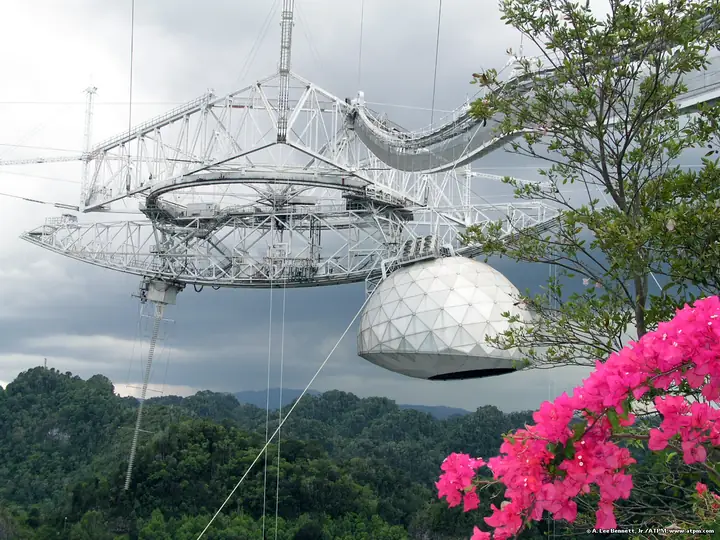
The telescope as it looked before the 2020 collapse.
What the site is now: Arecibo C3
In September 2023, NSF awarded more than $5 million over five years to create the Arecibo Center for Culturally Relevant and Inclusive Science Education, Computational Skills, and Community Engagement, known as Arecibo C3 or AC3. Cold Spring Harbor Laboratory leads the center in partnership with the University of Puerto Rico–Río Piedras, Universidad del Sagrado Corazón and the University of Maryland, Baltimore County. The site remains federally owned. Its programs cover astronomy, biology, computer science and data science, with a strong focus on students and communities in Puerto Rico.
Science has not stopped at Arecibo completely. NSF reports that the site still has a 12-meter radio telescope, an optical facility and a lidar facility.
What you can see and do
Public visits are based at the Ángel Ramos Foundation Science and Visitor Center, which first opened in 1997. AC3 calls it the best vantage point for seeing the preserved remains of the dish. You view the wreckage from designated areas only. You cannot walk out to the dish or the fallen platform.
- Signals exhibition. This is the center's new flagship exhibit, about how sound, light, radio waves, data and living systems carry information, and about discoveries made in Puerto Rico. A public preview opened in March 2026, and the full installation is planned to follow.
- Arecibo's legacy. Exhibits and talks cover the observatory's research history, including artifacts recovered from the telescope and its platform.
- Programs. Saturday hands-on STEM activities, field trips by reservation, and occasional special events. Most public programs last one to three hours.
Planning your visit
AC3 is still bringing facilities online and runs limited public hours. In spring 2026, general public hours were Friday afternoons and Saturdays, and field trips ran on weekdays by reservation. Schedules change, so check the hours and calendar on the official Arecibo C3 visit page before you go.
- Tickets. Every visitor needs a ticket, and AC3 asks you to buy online in advance rather than turning up at the gate. Prices are low, with discounts for children and seniors. Current rates are on the tickets page.
- Walking. From parking, the walk to the visitor center takes about 15 to 20 minutes over uneven ground, slopes and stairs. Because the site is a historic district, not every area is fully accessible. Contact AC3 ahead if anyone in your group has limited mobility.
- Food. No food, drinks or vending machines are available during public visits. Bring water and snacks.
- Radio quiet. You will be asked to switch phones off or to airplane mode.
- Photography. Personal photos are fine. Drones and tripods are not allowed anywhere on the site.
- Pets. Only service animals are allowed.
- Parking is free but limited.
Getting there
The site is in the karst hills south of the town of Arecibo. From San Juan, take PR-22 west to Arecibo, then follow signs and GPS south on narrow, winding rural roads to the observatory. Allow well over an hour each way from the San Juan area, and more in weekday traffic. There is no practical public transport, so you will need a car or a tour.
Combine it with
- Cueva Ventana, a guided cave walk off PR-10 that ends at a window over the Río Grande de Arecibo valley.
- Río Camuy Cave Park, nearby in the same karst country. It has been closed since 2023, so check its status first.
- Cueva del Indio, a coastal cave with Taíno petroglyphs on the Arecibo shoreline.
- Río Tanamá, for guided river and canyon outings.
Good to know
- There is no working giant telescope here. Come for the history, the exhibits and the view of the preserved remains.
- Look for "Arecibo C3" or "AC3" when you search for tickets and hours. Older listings for the "Arecibo Observatory visitor center" are often out of date.
- Questions about visits go to the contacts on the AC3 website. Background on the collapse and the site's future is on NSF's Arecibo page.
- Plan on one to three hours on site, depending on the program, plus driving time.