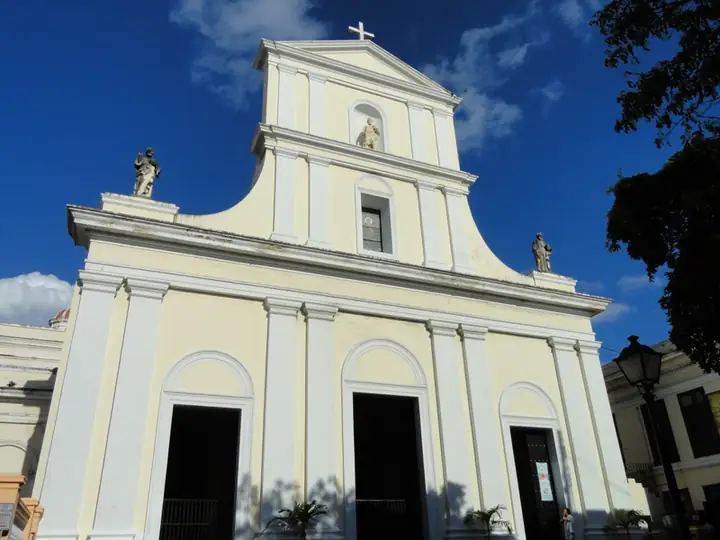
Halfway up Calle del Cristo, facing a small plaza and the old Carmelite convent, stands the Catedral Metropolitana Basílica de San Juan Bautista, the seat of the Catholic Archdiocese of San Juan. Its roots go back to the first decades of Spanish settlement, and it ranks among the oldest cathedrals in the Americas; only Santa María la Menor in Santo Domingo is usually placed ahead of it. Most visitors come to see the tomb of Juan Ponce de León, but the building itself, cool and calm after the bright street outside, is reason enough to step in.
Five centuries in brief
In 1511 Pope Julius II created three dioceses in the New World, one of them in Puerto Rico. Its first bishop, Alonso Manso, is regarded as the first Catholic bishop to arrive in the Americas. The cathedral was founded in 1521, at first as a simple wooden church. A hurricane destroyed it in 1529, and a stone church was built in its place in the 1530s and 1540s.
That Gothic church did not survive intact. Storms, wear and an earthquake in 1787 forced a major reconstruction that was completed in 1802, and the building was restored again in 1917, which accounts for much of what you see today. The original Gothic style survives in a few vaults in the northeast corner of the building, rare examples of the style in the Americas, so look up as you walk the aisles. In 1978 Pope Paul VI made the cathedral a minor basilica, and Pope John Paul II visited in 1984.
Restoration is an ongoing need. In May 2026 Governor Jenniffer González signed Law 93-2026, which lets the San Juan Monuments Board issue tax-exempt bonds to pay for the cathedral's restoration and maintenance, a mechanism previously available only for the nearby San José Church. If work is under way when you visit, parts of the interior may be closed.
What to see inside
- The tomb of Juan Ponce de León. The conquistador led the Spanish settlement of Puerto Rico from 1508 and was its first governor. He died in Cuba in 1521 after being wounded on an expedition to Florida. His remains were later brought to San Juan and kept for centuries in the San José Church before being moved here in 1908 to the white marble tomb near the transept. The story that he was searching for a "Fountain of Youth" was attached to him after his death and is best treated as legend.
- The relic of San Pío. In a glass case lies the body of Saint Pius, an early Roman martyr, covered in a wax figure. It has been displayed here since the 19th century and is one of the building's most talked-about objects.
- The shrine of Our Lady of Divine Providence, Puerto Rico's patroness, and a shrine to Blessed Carlos Manuel Rodríguez, the first Puerto Rican to be beatified.
- The Gothic vaults in the northeast corner, the oldest visible part of the structure, plus the side chapels, stained glass and religious art.
- The facade and Plaza de las Monjas outside, the little square in front, with the former Carmelite convent (now a hotel) across the street.
Visiting: hours, Mass and etiquette
This is a working cathedral with daily services. It is generally open to visitors during the day outside Mass times, and there is no admission charge, though donations help with upkeep. Visiting hours and the Mass schedule change, and the cathedral may close for weddings, funerals and special liturgies, so check the cathedral's website or call ahead rather than relying on hours printed in older guidebooks.
A few courtesies:
- Dress modestly: cover shoulders, and skip swimwear and very short shorts.
- If a Mass is in progress, either join it or wait until it ends before walking around the nave.
- Keep voices low and turn phones to silent. Ask before using flash.
Attending Mass is the best way to hear the building used as intended. Masses are celebrated mainly in Spanish.
Getting there
The cathedral is on Calle del Cristo in the western half of Old San Juan, about five minutes' walk uphill from the San Juan Gate and the Paseo de la Princesa, and 15 minutes from the cruise piers. There is no parking at the cathedral. Leave the car in one of the public garages on the south side of the old city (Covadonga and Doña Fela are the largest) and walk. The blue cobblestone streets around it are steep in places, so wear comfortable shoes.
Practical tips
- How long: 20 to 30 minutes is enough for most visitors; longer if you attend Mass.
- When: mornings tend to be quieter. The interior is a welcome break from the midday heat.
- Accessibility: the surrounding cobblestone streets are steep and uneven, and the climb up from the San Juan Gate is the hardest approach. A taxi or rideshare dropping you as close as the narrow streets allow saves most of the walk; call the parish office ahead if you need help with the entrance.
Combine it with
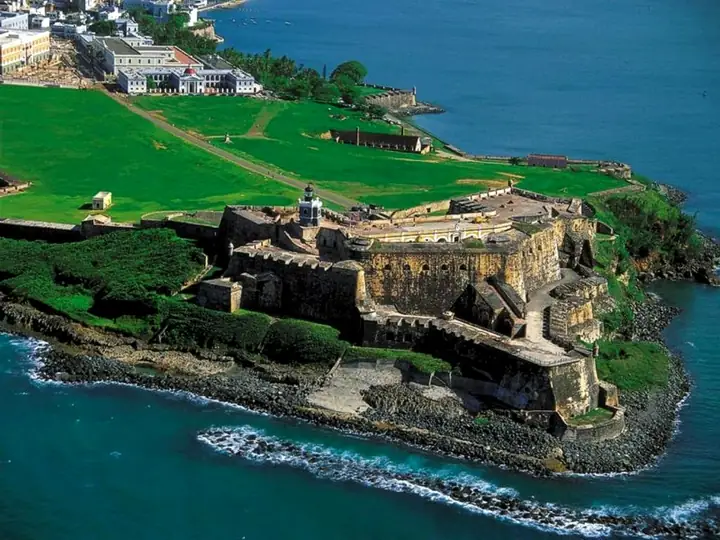
The cathedral sits at the center of Old San Juan's best walking route. Walk downhill along Calle del Cristo to the Capilla del Cristo and Parque de las Palomas, then over to La Fortaleza. Uphill, Calle del Cristo leads to the San José Church, where Ponce de León was first buried in San Juan, and on to El Morro. The Paseo de la Princesa is a short walk down through the San Juan Gate.
Good to know
- Free to enter; donations welcome.
- Check hours and Mass times before you go; schedules change and restoration work may close sections.
- Dress for a church, not the beach.
- The plaza in front is a good spot to rest in the shade before continuing your walk.