At the bottom of Calle Fortaleza, on the old city wall above San Juan Bay, stands the mansion where Puerto Rico's governors live and work. La Fortaleza, also called the Palacio de Santa Catalina, began as the first fortification in San Juan and is considered the oldest executive residence in continuous use in the Americas. It shares UNESCO World Heritage status with the city's forts and walls, inscribed together in 1983 as "La Fortaleza and San Juan National Historic Site." Unlike El Morro, it is a working government building, so how much of it you see depends on the day.
From fortress to palace
Construction ran from 1533 to 1540, ordered by Charles I of Spain after raids by Carib warriors and growing threats from rival European powers. The original building was little more than a fortified house: thick stone walls around a courtyard and a round keep, the Torre del Homenaje, which still stands. A second tower, the Torre Austral, came later in the 16th century.
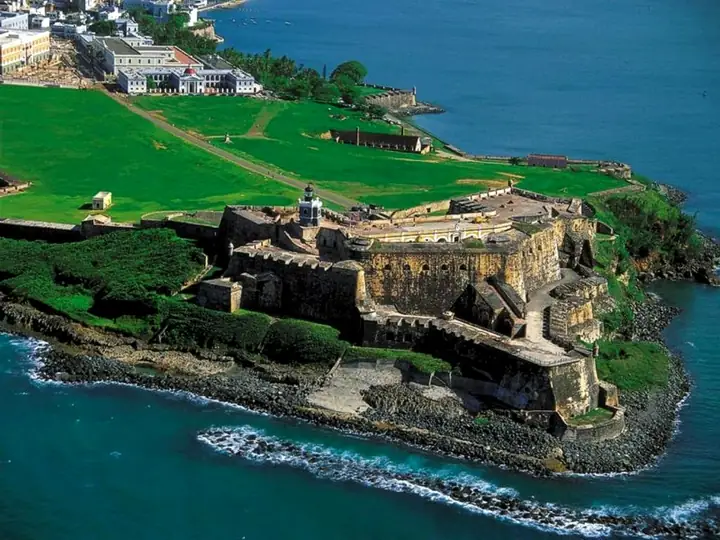
As a fortress it had a poor location. It sat inside the bay, too far from the harbor mouth to stop ships from entering, which is why Spain soon began building El Morro on the headland. La Fortaleza was taken twice: by the Earl of Cumberland's English force in 1598 and by the Dutch under Boudewijn Hendricksz in 1625. The Dutch set it on fire before they withdrew.
After that, the building's role shifted for good. When it was rebuilt in the 1640s a chapel dedicated to Saint Catherine was incorporated into the walls, which is where the name Palacio de Santa Catalina comes from. From then on it served as the residence of Spain's governors and captains-general. In 1846 it was remodeled into the Neoclassical palace you see today, with a new street facade. Spanish rule ended in 1898, and the building has housed the island's governors ever since, first U.S.-appointed and, since 1949, elected. By the governor's office's count, about 170 governors have lived here.
A popular story says that as Spanish rule ended, the departing governor struck a hall clock with his sword to stop time at the moment of transfer. It is a good tale; treat it as legend.
What you can see
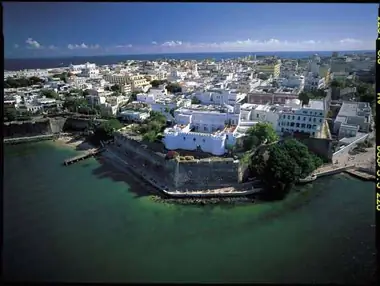
Even without going inside, the setting is worth the walk. From the end of Calle Fortaleza you look straight at the mansion's gates and facade, framed by the narrow street. The best way to appreciate the building is from below: walk along the Paseo de la Princesa to the San Juan Gate and look up. From the bay side you can see how La Fortaleza sits directly on the city wall, with the old round tower and the gardens behind it.
Guided tours take you past the gates into the oldest parts of the complex; the governor's private and formal quarters on the upper floors are not part of the visit.
Tours: what to expect
According to the governor's office, free guided tours are offered in English and Spanish, Monday through Friday, between 8 a.m. and 5 p.m. They cover the ground level of the building: the original military fort, the round tower, the terrace on the city walls and the gardens. You can reserve through the form on the official La Fortaleza tours page or by phone through the number listed there. Booking ahead is the safest approach.
A few rules apply. Every visitor 18 or older must show a valid photo ID or passport, appropriate clothing is required (leave the beachwear at the hotel), and minors must stay with an adult. Because this is a working seat of government, tours can be cancelled at short notice for official events, visiting delegations or security reasons; tours were suspended entirely for a time during the pandemic. Reconfirm the day before.
Expect security screening and a visible police presence. Calle Fortaleza is also where Puerto Ricans come to protest; the mass demonstrations of July 2019 that led to Governor Ricardo Rosselló's resignation filled this street, and access near the gates can be restricted when demonstrations are planned.
Getting there
La Fortaleza is on the southwestern edge of Old San Juan, at the western end of Calle Fortaleza. On foot, it is roughly ten minutes from the cruise piers and from the public garages on the south side of the old city (Covadonga and Doña Fela are the largest). Driving to the building itself makes little sense: the surrounding streets are narrow, parking is scarce, and traffic is sometimes restricted for security.
Practical tips
- Allow 15 minutes for a look from outside, and plan extra time around a reserved tour for security screening.
- Best light: late afternoon, when the sun is low over the bay and the Paseo de la Princesa is in shade.
- Photography: fine from the street and the Paseo; follow guards' instructions near the gates.
- Accessibility: Calle Fortaleza is paved with blue-gray adoquines (cobblestones) and slopes; the Paseo de la Princesa below is flat and easier for wheelchairs and strollers.
Combine it with
La Fortaleza sits in the middle of a compact walking loop. Head down through the San Juan Gate and stroll the Paseo de la Princesa along the bay. Or go uphill: the Cathedral of San Juan Bautista is a few blocks north on Calle del Cristo, and at the street's southern end are the Capilla del Cristo and Parque de las Palomas, which looks out over the same stretch of wall. Calle Fortaleza itself, running east toward Plaza Colón, is one of the old city's main streets for shops, cafés and restaurants. The forts, El Morro and San Cristóbal, are 15 to 20 minutes away on foot.
Good to know
- La Fortaleza is a working office and home, not a museum; access is never guaranteed.
- Tours are free, weekdays only, and best reserved in advance.
- Adults need photo ID; dress as you would for a government office.
- The mansion has hosted U.S. presidents including John F. Kennedy and Barack Obama, and roughly 170 governors have lived here.