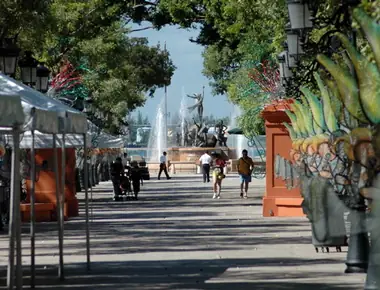
The Paseo de la Princesa is the tree-lined promenade that runs along the south side of Old San Juan, between the bay and the base of the 17th-century city walls. It is flat, shaded and free, which makes it the easiest stroll in the old city and a natural first stop if you arrive by cruise ship or park near the waterfront. Locals use it the way the Spanish intended in the 1850s: for an evening walk, a bench by the water and a cold piragua.
A little history
The promenade was laid out between 1852 and 1854 and named for the Princess of Asturias, Infanta Isabel, the firstborn daughter of Queen Isabella II of Spain. It was designed as a fashionable public walk outside the walls, at a time when San Juan was still a tightly enclosed military city.
Its anchor building is older. The long, low neoclassical structure along the Paseo opened in 1837 as the Real Cárcel de la Princesa, a royal prison, and remained a jail until 1965. After decades of neglect, the building and the promenade were restored and reopened in 1989, and the former prison became offices of the Puerto Rico Tourism Company.
The Paseo was damaged in the 2017 hurricanes; the Tourism Company and the National Park Service, which manages the adjacent city walls, worked together to repair it, and the promenade has long since reopened.
What you'll see
The promenade is about half a mile long. Starting from the eastern end near the cruise piers and La Puntilla, you walk west with the bay on your left and the walls rising on your right.
- The old La Princesa prison, on the eastern stretch of the Paseo.
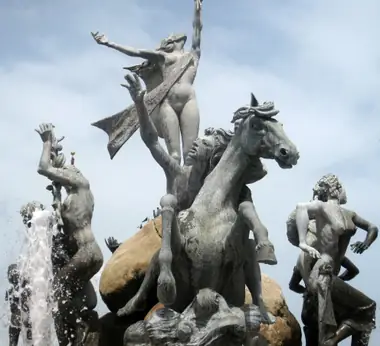
- The Raíces Fountain (Fuente Raíces), the large bronze fountain at the bay's edge, unveiled in 1992. Sculpted by Luis Sanguino, it represents the Taíno, African and Spanish roots of Puerto Rican identity. It is the Paseo's main photo spot.
- The city walls, which rise as much as 40 feet above the path as you continue west, with garitas (sentry boxes) on the corners.
- Bay views across to Cataño, home of Casa Bacardí, and the harbor traffic, with La Fortaleza visible on the wall above you near the end.
- The San Juan Gate, where the promenade ends. Walk through it and up the hill to reach the Cathedral.
Expect Victorian-style lampposts, benches under large trees, food and drink carts, and on weekends artisans selling crafts, plus musicians and families out for the afternoon. The Tourism Company uses the Paseo for events such as its artisans' fair, and it gets especially busy around the holidays.
What to eat and drink
The carts along the Paseo are part of the experience. Look for piraguas, shaved ice doused with syrup (tamarind, coconut and passion fruit are local favorites), coconut water served straight from the shell, and fried snacks such as alcapurrias and bacalaítos. Bring small bills; not every vendor takes cards.
Getting there and parking
The Paseo starts at the southwestern corner of the old city, a few minutes' walk west of the cruise piers. If you are driving, the closest options are the public garages on Calle Recinto Sur and the Covadonga garage near the bus terminal, plus the open-air La Puntilla lot at the start of the Paseo. Garages fill up on weekends, holidays and cruise days, and La Puntilla has been reserved for residents during big festivals such as the Fiestas de la Calle San Sebastián, so arrive early or take a taxi or rideshare instead.
Public buses from the Metropolitan Bus Authority (AMA) terminate at the Covadonga terminal, about ten minutes' walk away. Check the AMA's current routes before relying on them.
Practical tips
- Best time: late afternoon into sunset. The sun sets over the bay, the walls block the worst of the heat, and the Paseo fills with locals. Early morning is quiet and good for photos.
- How long: 30 to 45 minutes for an unhurried walk end to end, longer if you stop to eat.
- Accessibility: the Paseo itself is flat and paved, one of the most wheelchair- and stroller-friendly walks in Old San Juan. Getting back up into the old city from the San Juan Gate involves a steep slope; going back the way you came avoids it.
- Safety: the area is busy and generally comfortable day and evening. As anywhere crowded, keep an eye on bags and phones.
- Cats: you will see many of Old San Juan's well-known street cats along the walls. Please don't feed them on your own.
The Paseo del Morro
At the San Juan Gate the Paseo de la Princesa meets the Paseo del Morro, a National Recreation Trail that continues along the base of the walls toward El Morro. It is managed by the National Park Service and has had extended closures in recent years: first in 2023 for a water leak in the wall, and again in 2026 for a U.S. Army Corps of Engineers restoration project expected to close part of the trail for more than a year. Check with San Juan National Historic Site before planning to walk it.
Combine it with
Right next door, the Bahía Urbana waterfront park extends the walk east along the piers. Up through the San Juan Gate you reach the Cathedral of San Juan Bautista, La Fortaleza, the Capilla del Cristo and Parque de las Palomas, all within a few blocks. Plaza Colón and Castillo San Cristóbal are 10 to 15 minutes uphill to the east.
Good to know
- Free and open to the public at all hours; it is liveliest from late afternoon on weekends.
- The former prison is an office building, not a museum.
- Bring cash in small bills for the food carts.
- It is the easiest walk in Old San Juan for anyone with limited mobility.